March 2026
 Download the full report
بيان صحفي
On February 22, 2011, Muammar Qadhafi went on air with a chilling call to arms, urging his supporters to take to the streets and attack protesters challenging his four decades of authoritarian rule in Libya. Qadhafi, the country’s late de facto leader, promised to “cleanse Libya, house by house.” His comments sparked a scramble in Washington and European capitals to freeze the regime’s assets held abroad, both to prevent them from being used against the population and to preserve them for the country’s future., On February 25, 72 hours later, the United States issued Executive Order 13566, freezing nearly $30 billion of Libyan state assets held in US banks. Less than a month after that, on March 17, the UN Security Council (UNSC) issued Resolution 1973, freezing the international assets of five Libyan state entities for being “under control of Muammar Qadhafi and his family, and potential source of funding for his regime.”
Among those entities was the Libyan Investment Authority (LIA). Fifteen years later, the UN has long since lifted the freeze on the other institutions, but the freeze on the LIA remains in place. The asset freeze has deeply impacted the LIA. However, while it is a widespread assumption that the freeze affects all of the LIA’s assets, this is not the case. To understand the impact of the sanctions, we must first understand the total value of the LIA’s assets. While the LIA’s own estimates have limitations, the best available assessment for these assets, made in 2020 by Deloitte, is $62.85 billion. The Sentry calculates that around two thirds of these assets ($40-43 billion) are frozen, leaving one third (around $20-23 billion) not subject to any freeze.
However, the LIA also has the ability to actively manage at least $9.5 billion of those frozen assets via licenses obtained from sanctioning authorities. This means that—when combined with the approximately one third of the LIA’s assets that are not subject to sanctions—the LIA remains able to actively manage around half of its total assets, or $30-33 billion.
Given this, the Libyan people should expect that the billions of dollars invested since prior to 2011—or at least those assets not subject to any sanctions—should be delivering a return on investment. Instead, the total value of the LIA’s assets has in fact fallen since 2011, and the assessed value of the assets that were not frozen or for which licenses were obtained has not increased.
Nonetheless, the asset freeze has limited the LIA’s ability to operate effectively. The LIA has campaigned in recent years for the freeze to be partially lifted, claiming that it has been undertaking a transformative process to improve accountability and transparency., But as the LIA paints a public picture of positive strides, it has failed to come to grips with the flaws in its sprawling organization.
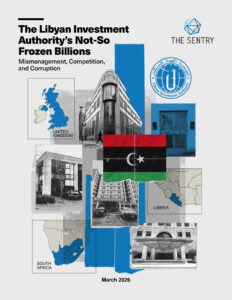
By examining the LIA’s activities in the United Kingdom (UK), South Africa, Liberia, and elsewhere on the African continent, The Sentry has identified ongoing issues that have led to the mismanagement of billions of dollars of assets that are not subject to any asset freeze and the failure to effectively navigate sanctions designations where assets have been frozen—calling into question the LIA’s public narrative. The LIA did not respond to The Sentry’s request for comments concerning its findings in this report.
Despite public reform claims, the LIA has allowed a $72 million London building to sit vacant for a decade, losing an estimated $79 million in rent. This mismanagement is compounded by cronyism: Libyan Prime Minister Abdelhamid Dabaiba’s son-in-law was appointed to run an LIA subsidiary in the UK, where his increased expenditures led to additional financial losses.
In South Africa, major Libyan real estate investments in Johannesburg’s “richest square mile” have provided no evidence of any return on investment in over two decades. The LIA-owned Michelangelo Hotel, which was the anchor hotel of the 2010 World Cup and jewel of the LIA’s South African real estate portfolio, has been closed since 2020. The LIA subsidiary that owns it has not settled a $110 million loan granted for the purchase of a real estate block that houses another hotel and some of the world’s most luxurious brands.
In Liberia, it appears the LIA has failed to derive any income at all from its assets. The LIA subsidiary that owns a building once leased to the UN in the capital Monrovia seems to have lined the pockets of individuals connected to former Liberian President Ellen Johnson Sirleaf. The Libyan Audit Bureau declared that other million-dollar Libyan projects in Liberia had been “nationalized” or mothballed. The LIA has made no apparent effort to recover its assets.
Finally, in the case of Ola Energy, an LIA-owned fuel company operating across 17 African countries, the company’s management was seemingly appointed based not on their expertise but rather as a result of political considerations., This management proceeded to rapidly scale up spending, incurring losses and even falling afoul of Moroccan regulators for insider trading. Moroccan authorities fined the company more than $10 million.
Together, these findings expose a very different picture than the one the LIA is presenting to the UN Sanctions Committee, revealing insights into the systemic problems the LIA faces.
Key recommendations
- The UNSC should not ease current restrictions on the LIA until Libya achieves more thorough and transparent governance standards for its sovereign wealth fund. Providing access to frozen funds—even under oversight from the Security Council—would remove the LIA’s incentive to better manage the assets.
- The UNSC should therefore condition further sanctions relief upon benchmarks for improved LIA governance and transparency. By more clearly seeking to extract improvements as a precondition for further access to frozen assets, the UNSC will also help those in the LIA who are committed to better stewardship of Libya’s sovereign wealth push back against the political and coercive pressures that they face from vested interests. Without such efforts, Libya’s frozen billions will simply slide into the pockets of politically exposed persons (PEPs) and be lost to the Libyan public.
- The LIA should publicly release a copy of its audit, asset valuation, and consolidation of accounts, acknowledging shortcomings. This should include a statement recognizing where assets may need to be written off if they have been lost or mothballed.
- The LIA should publish an annual report detailing its financial performance, including the returns its assets are generating and progress towards compliance with the Santiago Principles.
- In keeping with the repeated findings of the Libyan Audit Bureau, the LIA board should urgently conduct an audit of those holding positions within the LIA’s ecosystem to address repeated conflicts of interest in the management of its subsidiaries. This should also include an assessment of the PEPs contracted by the LIA.
- If the LIA does not agree to these conditions, the UNSC should insist upon a forensic audit of the LIA’s assets and accounts to definitively clarify the status of its governance and guide further decisions.