
Leaked financial records partially support Vice President Chiwenga’s implicit claim that profits have been diverted away from Sakunda’s shareholders.
Background
In 2017, General Constantine Chiwenga, as head of Zimbabwe’s armed forces, led the military coup which brought President Emmerson Mnangagwa to power and won Chiwenga the vice presidency. The two have since fallen out and are fighting over Mnangagwa’s apparent desire to stay in office for an unconstitutional third term.
Vice President Chiwenga’s allegations
In September 2025, Chiwenga brought the fight to the ZANU PF politburo, one of the party’s highest decision-making bodies. The Vice President submitted a dossier alleging that criminals surrounding the president were corrupting the ruling party. The document, obtained by ZimLive, contained an explosive allegation concerning fuel giant Sakunda Holdings and its partial owner Kudakwashe Tagwirei, a close ally of Mnangagwa and rumoured to be a rival candidate to Chiwenga to succeed the President. Sakunda’s joint venture with commodity trading giant Trafigura sold fuel worth between $600 million and $800 million each year from 2014 to 2017, while from 2016 to 2019 Sakunda received over $1 billion in public funds to buy seed and fertilizer in the controversial Command Agriculture program. Specifically, Chiwenga complained of:
“the stealing and concealment by Kudakwashe Tagwirei of the Party’s 45% shareholding in Sakunda Holdings held by Mvuto Investments (Private) Limited, an investment vehicle of the Party held through our National Reconstruction Group, which was purchased in November 2013.”
In October 2025, ZANU PF’s legal secretary Ziyambi Ziyambi hit back at Chiwenga, circulating a rebuttal document. Ziyambi denied that the party holds shares in Sakunda, although he maintained a careful silence about the National Reconstruction Group and Mvuto Investments.
Who is behind Mvuto Investments and the National Reconstruction Group?
In 2014, Mvuto Investments’ shareholders were Happyton Bonyongwe—the then director general of the Central Intelligence Organisation (CIO), the country’s spy agency— and two former ministers: Walter Chidhakwa and the late Joel Biggie Matiza. Mvuto’s links to the CIO do not end there. The company’s registered address was the fifth floor of Livingstone House, an address frequently used by the CIO to register its companies. Further, Mvuto and Sakunda appear to share the same company secretary, who had also played a similar role at a CIO-controlled firm. Maurice Makoni was appointed as the company secretary for Mvuto Investments, Todware Investments—a CIO-linked solar energy company—and Sakunda Holdings in 2014.
The National Reconstruction Group’s existence was first inadvertently revealed by Bonyongwe, when the former spy chief gave evidence to a Parliamentary inquiry into the CIO’s co-ownership of Kusena Diamonds, a mining company. He left his briefing papers on public view, showing that the CIO owned 10% of Kusena, with 40% held by the National Reconstruction Group, “which represented Zanu PF.” The National Reconstruction Group had also purchased agricultural goods worth $2 million in 2013. These may have been used by ZANU PF for distribution in rural areas to help buy votes in the election that year.
Did Mvuto Investments really own 45% of Sakunda?
Sakunda’s records at Zimbabwe’s corporate registry (which frequently has filings that are out of date or incomplete) do not mention Mvuto Investments. The Chief Operating Officer of Sakunda has claimed in parliamentary hearings that 54% of the company is owned by Tagwirei, with the remaining 46% held by Tagwirei’s wife, Sandra Mpunga.
However, Chiwenga’s pointed mention of the National Reconstruction Group, the presence of the former CIO boss on the board of Mvuto Investments, and Tagwirei’s experience with hidden ownership structures raises the possibility that this might not be the whole story.
Sakunda’s beneficial owners may also have changed over time. One source in a position to know said that they were unaware of Mvuto when they, the source, were appointed to the position in which they had access to relevant information in 2018 but claimed that Mnangagwa played a role: “Kuda [Tagwirei] always said Sakunda was not just his, and President was also owner [sic].”
If Chiwenga was right, how much would ZANU PF have lost?
Suppose Chiwenga was correct, and the National Reconstruction Group really should have owned 45% of Sakunda via Mvuto Investments—did the ruling party lose out financially?
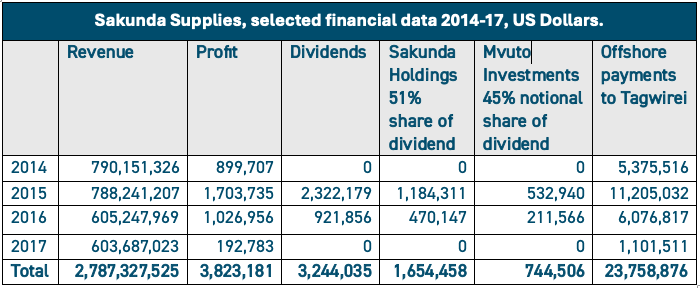
We can provide a partial answer by comparing the audited accounts of Sakunda Supplies, Sakunda Holding’s joint venture with Trafigura, and a leaked spreadsheet, first obtained by the Organized Crime and Corruption Reporting Project (OCCRP), which details offshore payments to Tagwirei.
If the allegation made by the Vice President is correct, the relationship between Sakunda Holdings, Sakunda Supplies, and Mvuto Investments should have looked like this:
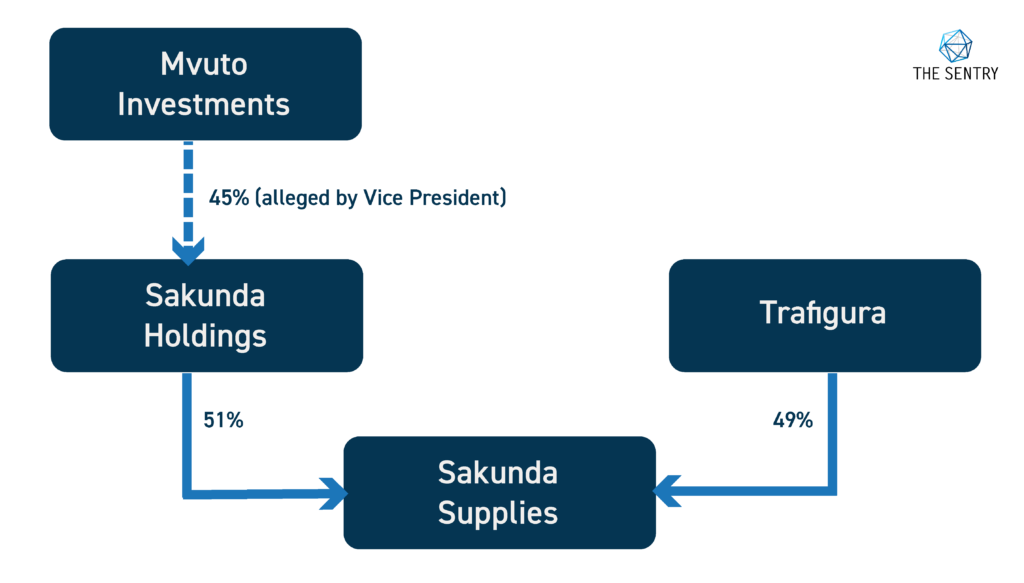
One standard route for a shareholder to get paid is through dividends, paid out of post-tax profits. However, many privately-owned companies seek to report lower profits, which incur corporate income taxes, and instead aim to extract value in other ways. This is the pattern we see at Sakunda Supplies. Tagwirei was contractually entitled to fees from Trafigura that dwarfed the dividend payments. During the 2014–2017 period, Tagwirei received $23.7 million offshore, while any 45% shareholder of Sakunda Holdings—in this scenario, Mvuto—would have earned less than $1 million from Sakunda Supplies’ dividends, assuming that Sakunda Holdings itself paid any dividend during that period.
Trafigura declined to comment to The Sentry but had previously told the OCCRP that the details presented to the firm by the media organization were “factually inaccurate.” Tagwirei also told the OCCRP that he denied all the accusations put to him but did not respond to The Sentry’s request for comment.
Conclusion
Chiwenga’s allegations have not been answered adequately by ZANU PF’s legal secretary, and both the party and Sakunda still have questions to answer about their precise relationship. If ZANU PF did hold a hidden stake, then these leaked financial documents suggest the vice president may have a point when he complains of “concealment.”