
September 2026
Three years after the Alliance of Sahel States was founded in the name of sovereignty and security, airstrikes are killing civilians through an opaque and unaccountable chain of command.
On the night of May 18, 2026, a drone approached from the south and circled for half an hour over Hassi Sidi, a desert way station in Mali’s Timbuktu region where travelers returning from gold pits across the Algerian border were settling in for their evening meal. Nobody worried—the wells were known as a civilian stopping point, even to the army. Sometime after midnight, a jet dropped a bomb on the sleeping men. A family member of a survivor described the attack to The Sentry. At least five people were killed, and two were never found.
On September 16, 2023, the military governments of Mali, Burkina Faso, and Niger signed the Liptako-Gourma Charter, founding the Alliance of Sahel States both as an architecture of collective defense and a declaration of sovereignty. Three years on, the air war in Mali is the alliance’s flagship campaign, intended to counter several insurgencies. Turkish Bayraktar TB2 drones arrived to support the campaign in December 2022, followed by the heavier Akıncı in 2024, and Russia has supplied drones and fighter jets to Wagner Group and Africa Corps operatives in Mali since 2022. Airstrikes have since killed civilians across the north and center of the country, with Amnesty International calling for some of the deaths to be investigated as potential war crimes. But who should be held accountable when civilians are killed? The paper trail—from the contract for Turkish-made Akıncı drones, obtained by The Sentry, to the shared flight operations at military bases across Mali—raises questions over which parties bear responsibility if international crimes were committed.
Two Suppliers, One Campaign
In supplying arms to Mali, Turkey and Russia are competitors, not partners. In 2024, Turkey tied with Russia as West Africa’s third-largest arms supplier, each contributing 11 percent of the region’s major arms imports, according to SIPRI data. The European Union (EU) Institute for Security Studies has noted the emerging rivalry between the two countries over Sahel procurement, and one source within the Malian Armed Forces (FAMA) confirmed as much to The Sentry. One possible sore point: Bamako apparently found $210 million for Turkish drones, while, as The Sentry reported in 2025, it has struggled to pay for Russian troops and equipment.
So far, this rivalry has not translated into direct operational competition between their forces in Mali. FAMA troops operate Turkish-supplied drones, with Turkish personnel involved in training and support, while Russia’s Africa Corps, the state-controlled successor to Wagner, operates aircraft supplied through its own military partnership with Bamako. The two systems therefore coexist rather than compete. The Turkish government and manufacturers deal with Bamako over the drones operated by FAMA, while the Russian government supplies and supports the Africa Corps. For now, Mali appears to be able to maintain the relationship with both Turkey and Russia without needing them to coordinate with one another. Instead, the competition is playing out over the longer-term question of which foreign partner will provide the equipment, expertise, and security assistance that Bamako depends on.
Hidden Dealings
On August 15, 2024, the Malian government signed a $210 million agreement with Turkish manufacturer Baykar to procure six Akıncı combat drones. Notably, the signatory on the Akıncı contract, reviewed by The Sentry, is not the Malian Ministry of Defense. Instead, it was signed by Colonel Modibo Koné, director general of the state security agency, l’Agence Nationale de la Sécurité d’État (ANSE), which answers directly to President Assimi Goïta rather than the army. One conflict researcher told Jeune Afrique that routing such a strategic purchase through the security service shows where the president’s trust lies and keeps the deal beyond the reach of the finance ministry and any public audit. The agency’s own resources are nowhere near the price of these drones. Mali’s 2024 finance law allocated the ANSE roughly $30 million, about one-seventh of the contract value. This means that Mali’s heaviest strike aircraft was commissioned by a spy agency organized around the president’s security—concentrating political authority and reducing institutional accountability—and were potentially purchased with money outside of its publicly disclosed budget. As of this report’s release, The Sentry had not been able to find a public account showing where the $210 million for the contract came from. This lack of transparency mirrors how The Sentry previously tracked ANSE’s budget swelling in 2022 to covertly cover Wagner Group payments, before shrinking again once the transactions were complete.
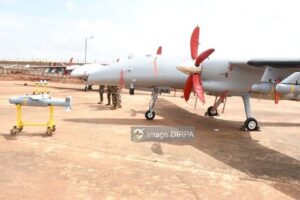
Akıncı drones handed over to the Malian armed forces at Sévaré, Mopti region, July 30, 2026. Photo: Direction de l’Information et des Relations Publiques des Armées (DIRPA).
The Manufacturer Is Not Responsible
Under the contract, reviewed by The Sentry, Mali alone would bear the consequences if an export license for any component of the system, or for the system itself, is refused. Article 19 of the contract lists circumstances beyond the seller’s control, or force majeure provisions, that excuse Baykar from delivering a complete aircraft, including the denial of an export license. If Baykar cannot obtain an export license for a single component or for the system as a whole, the contract treats that as force majeure, allowing the company to withdraw from the deal—and refuse delivery—without liability. Mali receives no equivalent protection. The article lists what will not count as force majeure for the buyer: an act of government, war, state restrictions, sabotage, an embargo, a terrorist attack, civil unrest, a coup, or an attempted coup. None of those events excuse the buyer’s obligation to pay.
The force majeure grounds are particularly sensitive because the Akıncı is not an entirely Turkish-made system. Like many advanced military aircraft, it depends on components and technologies produced abroad, leaving its availability and potentially its ability to operate partly subject to decisions by governments other than Turkey. The engines are the clearest example. Baykar’s chief executive, Haluk Bayraktar, said in 2021 that the Akıncı used the AI-450 turboprop engine built by Ukraine’s Ivchenko-Progress, and that other configurations of the aircraft take different engines. The B model, delivered to the Turkish Air Force in 2022, carries two 750 hp Pratt & Whitney Canada PT6A-135A engines. A third version, the C, first flew in February 2024 with two 850 hp engines, possibly of Ukrainian origin. Some governments have repeatedly used export controls to restrict, restore, or condition the transfer of components for Turkish-made drones, granting or revoking licenses based on the commercial and diplomatic interests of the states supplying the components. In April 2021, Canada canceled its permits for military goods and technologies, such as WESCAM targeting sensors on early TB2s, after wreckage surfaced in Nagorno-Karabakh, then resumed exports in January 2024 seemingly as part of the price for Turkey ratifying Sweden’s NATO accession.
This dependence on foreign components is also visible in Russia’s combat aircraft. Ukrainian teardowns of downed Su-34 and Su-35 aircraft, newer relatives of the bomber aircraft operating from Bamako, identified that 1,115 out of 1,119 components originated from firms in the US, Germany, Japan, South Korea, Taiwan, or France. The point is not that every foreign component in a Turkish or Russian aircraft is subject to the same export regime. Rather, these cases demonstrate the inherent interdependence of modern weapons systems. Manufacturers can remain dependent on foreign technologies even when the final platform is assembled domestically.
The Baykar contract also distances the company from the end use of its products, with Article 18 stating that Baykar bears no responsibility for damage, loss, or injury to people or property arising, directly or indirectly, from the use of its products. In promoting its products, Baykar focuses on the capabilities of its drones, as opposed to the strike themselves. Russian suppliers, however, have been more overt about operations in Mali specifically. ZALA Aero, the Kalashnikov Group company that makes the Lancet loitering munition, has a news section on its website featuring what it describes as Africa Corps strikes on terrorists in Mali. On July 25, 2026, it announced the Lancet’s first use in Mali. Posts through July showed what the company said were destroyed pick-up trucks or a camouflaged militant position. Then, on August 22, it published a full sequence: its Z-16 reconnaissance drone spotted the vehicles, the Lancet then struck them, and the Z-16 filmed the aftermath. The footage was credited to an Africa Corps Telegram channel. These posts, which named no specific villages and no death toll, are publicity rather than accountability. But the difference between these suppliers is stark: while Baykar’s contract distances the company from what happens when its drones are used, ZALA has put footage of its weapons in use on its own corporate news feed.
One of These Parts Is Not Like the Others
Because every aircraft in this campaign relies on components that cannot be produced domestically, the hardware itself provides a distinct avenue for accountability. The governments that license those parts hold a decisive form of leverage—one that Sahelian regimes cannot control, even if its application remains uneven. While export controls may be intended in part to restrict the spread of dangerous weapons, controls on easily replaceable parts, such as some sensors or cameras, have often driven local innovation. For example, when Canada cut off its sensor exports, Turkey answered with a domestically developed replacement, integrated onto the TB2. Restrictions on harder-to-develop technology, such as some engines and microchips, have at times proved effective. Russia, under the widest export controls ever applied to a major economy, has not developed domestic replacements for the foreign chips used in its aircraft. Instead, Russian procurement shifted to other foreign sources. Chinese suppliers took on a larger role, while intermediaries continued to transfer Western-made components into Russia. The chips themselves remained foreign made. This demonstrates the difficulty of severing a sophisticated military industry from a global electronics supply chain.
Some weapons have no irreplaceable parts at all. The first-person view (FPV) drone is assembled from inexpensive commercial components that largely fall outside of export control regimes. Since 2023, al-Qaeda affiliate Jama’at Nusrat al-Islam wal Muslimin (JNIM) and Azawad separatist groups have used drones in sustained attacks against Malian and allied forces. By July 2026, Africa Corps and the Malian military were also reporting their own FPV drone strikes in the area around Anéfis. Export controls in this war have worked component by component. A ban on a replaceable part can result in a short delay, and Canada’s sensor cut-off cost Baykar a few months before they developed their own; a ban on an irreplaceable part, however, can ground an aircraft. And where a weapon is built from commercial parts, as the FPV is, there may be nothing to ban.
When governments do restrict components outright, exporters and end users have found a second way around the controls by rerouting procurement through intermediaries or disguising the true destination of sensitive components. For example, in July 2025 Reuters traced Chinese engines shipped to Russia and disguised as refrigeration units, which were ultimately installed in Garpiya attack drones. Wreckage of a Garpiya was then recovered in Mali in May 2026. The broader lesson is that the availability of an advanced weapons system depends not only on the willingness of its manufacturer to sell it, but also on a complex international supply chain that can be disrupted by export controls. But at the same time, governments, companies, and intermediaries have found ways to circumvent those controls.
A Command Structure That Separates Decision from Execution
While the Turkish drones are Malian-flown, the Russian aircraft—based at the same airport—are not. In May 2025, the Africa Corps posted cockpit photographs of its own pilots flying a Su-24M bomber, captioned only as a strike in “an African country.” The Sentry’s Doubling Down investigation found that strike approvals for the air campaign in Mali run up to Russian commanders. In theory, that means a Malian crew can fly a Turkish-built drone against a target whose selection and approval has passed through a Russian command structure. The Sentry gathered testimonies detailing how these strikes occur: interviewees described Turkish drones as watching a target, while Russian jets conduct the actual strikes. While Bamako describes a sovereign counterterrorism campaign, targets are in fact approved by a foreign power.
For civilians in Mali, none of that chain of responsibility is visible. In Amasrakad, located in Mali’s Gao region, Amnesty International documented two Malian army drone strikes in March 2024 that killed at least 13 civilians, including seven children. In Kyrnia, located in Mali’s Mopti region, Human Rights Watch found that an Africa Corps Su-24 carried out airstrikes in June 2026 that killed eight civilians, including three children. But official accounts often tell a different story: the Malian army issued a statement on Amasrakad that contradicted witness and survivor accounts, while Africa Corps described the Kyrnia bombing as the killing of terrorist field commanders.
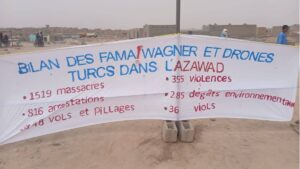
A banner denouncing FAMA, Turkish drones, and Wagner mercenaries at a march in northeast Mali’s Tin-Zaouatène commune, April 16, 2025. Photo: Facebook.
Conclusion
The Alliance of Sahel States marks its third anniversary this month. Three years into the air war flown in its name, one fact stands out clearest of all: no party involved has been held accountable to the citizens living beneath it. Every participant occupies a carefully defined position: Baykar manufactures but does not operate, the ANSE purchases drones that are then flown by the FAMA air force, and Russian commanders choose whether to approve a strike or not. This fragmentation impedes accountability. If each actor controls only part of the system, then no single actor answers for what it produces.
Recommendations
Export licensing authorities in Ukraine, Canada, and other states whose components are documented in aircraft produced in Turkey and operating in Mali: Kyiv, Ottawa, and other relevant jurisdictions should review the licenses to sell to Baykar against documented civilian harm and against the finding that strike approval in Mali runs through Russian commanders.
Sanctioning authorities in the EU, the United Kingdom, Canada, and Australia: Designate the ANSE Director General Modibo Koné, consistent with The Sentry’s April 2026 recommendation. The Akıncı procurement shows Koné personally directing another major security relationship through a channel outside of the finance ministry and public audit. This is a mechanism The Sentry previously traced to Wagner payments in 2022. The U.S. decision to remove certain Malian officials from its sanctions list does not preclude other jurisdictions from pursuing their own sanctions where the evidence supports doing so.
Governments and donors supporting accountability in the Sahel: Fund independent documentation and preservation of evidence of air-strike casualties in Mali, to standards usable in future proceedings. The Sahel states’ withdrawal from the International Criminal Court does not extinguish jurisdiction over crimes committed before it takes effect, as the ICC Appeals Chamber confirmed in April 2026.